
Sakura Hanami – Cherry Blossoms in Japan
0
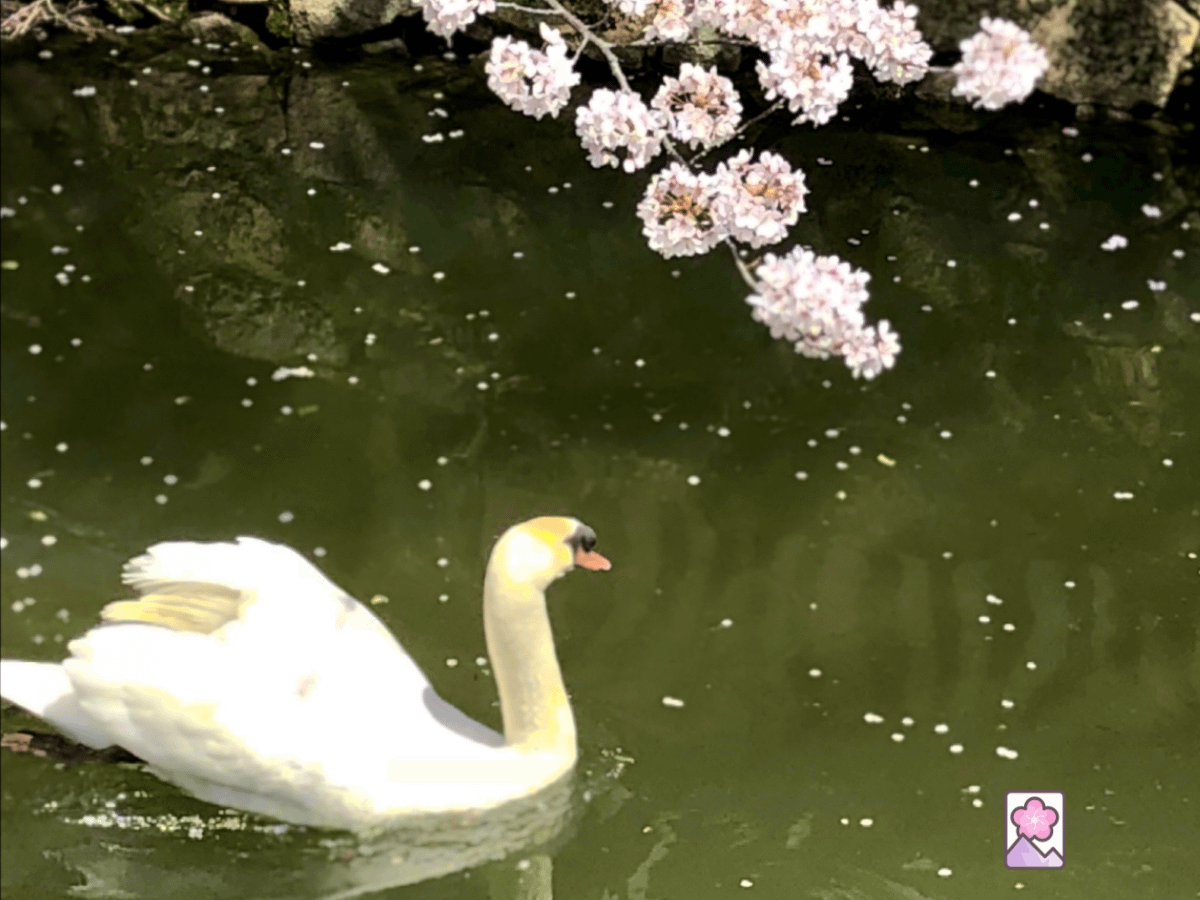
Many places have cherry trees and cherry blossoms, but few celebrate them as fervently as Japan does. Cherry blossom or sakura is surely the most…

It’s not all about food and making friends. Instead, from early age, school lunch in Japan teaches kids how to take care of cleanliness, estimate portions, understand nutrition, and take care of their food needs independently
School lunch in Japan is one of the famously well-organized and uniquely educational experiences.
It’s not all about food and making friends. Instead, from early age, school lunch in Japan teaches kids how to take care of cleanliness, estimate portions, understand nutrition, and take care of their food needs independently, without the help of teachers or parents.
Let’s take a look at the practices that make Japanese school lunch so special.
The Japanese school system contains many features that seem weird if you got your education in Western countries.
For example, most Japanese schools don’t employ cleaning staff – the students join forces to take care of the school’s cleanliness. Home economics is a regular subject in elementary schools, and kids also learn how to sew, cook, and generally take care of their health and possessions.
Japanese kids learn a lot of life skills in school, on top of academic education.
Good eating habits are an important life skill – so at 12:30 every school day, Japanese schools across the country perform an entire choreography of rituals during Kyushoku (給食) – the school lunch.
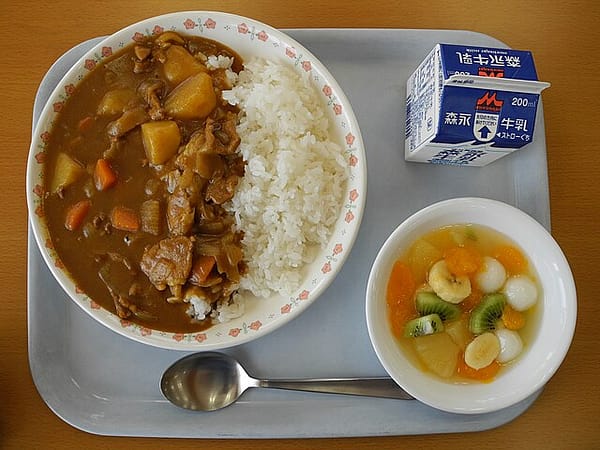 Kids’ favorite school lunch in Japan: curry, rice, fruit salad, and milk – what else do you need.
From prepping the classroom (there’s usually no cafeteria), bringing lunch to the classroom, distributing servings, introducing the day’s menu, saying “itadakimasu”, digging in (to the last rice grain), to finally getting the empty dishes back to the kitchen and cleaning the classroom once again – every step of the way done by students, with minimal guidance from teachers.
The Japanese school lunch is not only a time for food, it’s also an educational experience that instills healthy practices like cleanliness, mindful eating and appreciating the source of the food, a balanced diet, and avoiding waste (mottainai philosophy).
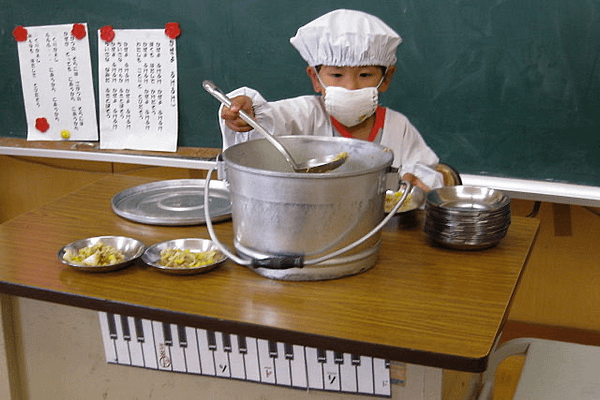 From a very young age, Japanese kids learn to take care of the school and independently serve school lunch
Many schools strive to integrate lunch and education. Many schools employ nutritionists who plan meals and educate kids about food. But education goes beyond that.
Along with table manners and nutritional habits, lunch teaches cooperation, cleanliness, and appreciation for food. In fact, students do almost all of the work – bring the food to the classroom, serve everybody, introduce the menu, and clean before and afterwards. It’s even mandatory to eat everything off of your plate.
Usually, eating is prefaced with a menu introduction, and it usually includes nutrition facts and food source info (especially if it’s a local specialty, like Hokkaido melons, Aomori apples, Kagoshima radish, or Gunma konjac).
Some schools may even have gardens where students grow some of the crops that will be served for lunch, teaching them the basics of agriculture, and perhaps more importantly, the long path that food takes from the seed to the table. Depending on the school, students may also occasionally help with preparing the food, like peeling vegetables.
Today, almost all (99.7%) elementary schools and most junior high schools (98.2%) in Japan offer school lunch. That is thanks to the focused effort of many initiatives and groups who brought affordable and nutritious school lunch up from its humble beginnings in 1889.
Is Japanese school lunch expensive?
Not at all! Lunch is subsidized, so it turns out quite cheap, about $3 per meal. Parents typically pay in monthly installments.
While most families pay for school lunch, there’s country-wide initiative to make lunch free for all kids in Japanese schools.
Unlike elementary and middle school, high schools don’t usually offer subsidized lunch, so students mostly buy ready-made lunch boxes at a kombini or bring bento boxes from home.
Some schools have kitchens on-site, and others serve food delivered from a central kitchen.
Many schools get their food delivered in large batches, and some get it in pre-packaged portions. In either case, students will take care of bringing lunch to their classrooms and distributing it among their classmates. There are no cafeterias – food is brought to the homeroom of each class.
Here’s how a central kitchen prepares thousands of lunch servings every day
Variety and balance are key in Japanese eating. Schools try to instill good eating habits, so these principles are strictly followed in selecting lunch meals too.
Meals are usually comprised of a few elements:
1. Carb: Usually, rice is served 3 times a week, and the other 2 days it either noodles or bread.
2. Protein: Typically, a single chunk of protein-rich food, like meat, fish omelet, or seafood.
3. Soup: Nearly always, there’s some sort of soup in a bowl. Soups come in an incredible variety, but miso, chicken, pork, tomato, and seasonal vegetables are commonly used soup bases.
4. Salad: Either pickled or fresh, salad usually contains a variety of seasonal veggies, seaweeds, and seeds. Almost always, salads chosen for school lunch are made of seasonal, locally-grown ingredients.
5. Milk: There’s always milk, for every child’s daily dose of calcium. Occasionally, it’s replaced with other dairy or Japanese green tea like hojicha.
6. An occasional dessert: Sometimes, desserts are also served with lunch. Usually it’s mochi or fruit. In general, snacks are not allowed or encouraged, but fruit is often found on the menu.
On top of generally serving tasty, nutritious, and affordable meals, Japanese schools also frequently forbid snacks. Whether that’s a candy bar in between lessons or a soda in the schoolyard, you generally won’t come across snacks or places to buy them. That means that most kids get quite hungry by lunchtime – making Kyushoku (lunch) a beloved daily ritual.
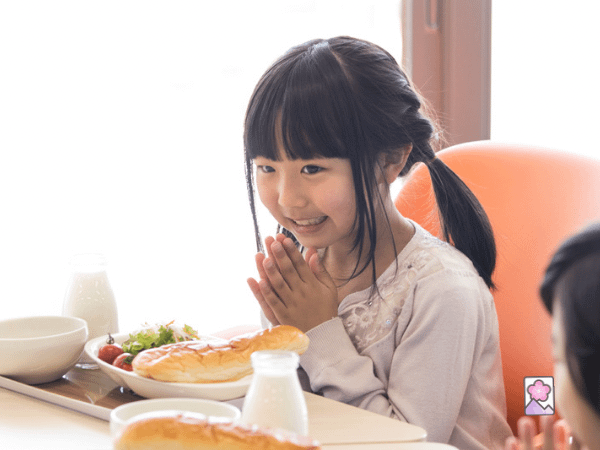
 Milk is a school lunch staple in Japan – it comes with every meal.
Everybody Participates: Student-led School Lunch
School lunch in Japan is like a daily choreography.
The team of students on lunch duty brings the lunch trolley to the homeroom. Even first-graders do this, even though it can be a physically demanding task (the trolley usually carries huge pots of hot soup and rice). To make it easier for kids, and to help them gradually get better at this, the youngest grades have classrooms closest to the kitchens/storage rooms.

Other students clean and prep the tables. In the past, it was common to put desks together into a few groups so students could communicate during lunch. However, since Covid, desks mostly stay in their original position facing the blackboard.
Either before eating or at the beginning of lunch, a student on duty introduces the day’s menu.
They’ll not only say the dish names, but also talk about the health benefits of key ingredients, and often put special emphasis on where the food comes from. Japan highly values local production and parts of the country are often famous for agricultural goods they produce – and Japanese kids learn to value this from a young age.
Students on duty pour servings in each classmate’s tray, and one of them distributes chopsticks or spoons.
In most cases, the serving station looks very much like a cafeteria: students approach with their trays and carry their lunches back to their desks.
In other cases, students take a serving tray from desk to desk, filling everybody’s plate.
It’s not uncommon for unassigned students to pick up tasks on their own, to speed up the process – everybody chips in because nobody starts eating before everyone’s ready.
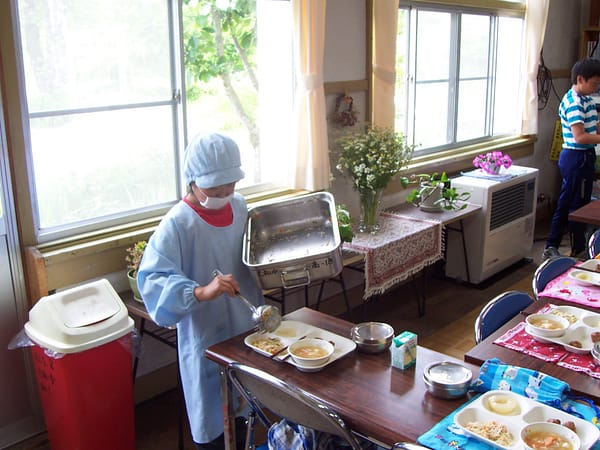 Lunch Duty!
When everyone is served and seated, it’s time to say “itadakimasu” (I humbly receive this food) and, finally, eat.
In general, it’s mandatory to eat everything. All plates and bowls must be cleared before they can be returned to the kitchen. This teaches Japanese kids to avoid waste. Thanks to the insight of the school nutritionist, even picky students gradually get used to various dishes that are not too attractive to kids.
Everybody must eat their fill, but what about seconds? If there’s some food left over, students can raise their hand to communicate they want to eat more – only after their first plate is empty, of course. If there isn’t enough for everybody who wants more (in reality this mostly only happens with dessert), it’s common to play “rock, paper, scissors” for the privilege.
Teachers usually eat with the students. The teacher is there to assist during the lunch preparations, but they don’t generally take any tasks themselves – rather, they support the students. And get their own serving of food from the class too.
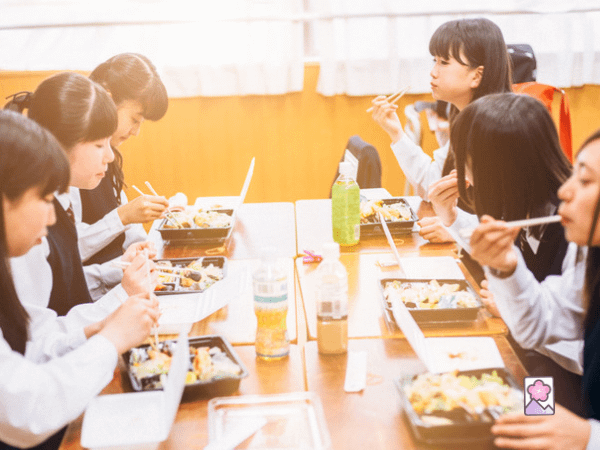
 This photo is from a Japanese high school, where students bring their own lunch and drinks every day. However, some things stay the same throughout education – like the arrangement of typical single-person desks into a dinner table.
After eating comes another round of cleaning.
Empty bowls and trays are gathered back to the trolley, and the lunch duty team brings it back to the kitchen.
In the meantime, other students clean the floors and desks to bring the classroom back to its educational shape.
In some schools, children (especially the youngest) wear special, hygienic overalls and caps during lunch. This is a good time to remove it. Some schools also teach kids to brush their teeth after lunch, in which case it helps that each classroom usually comes with a sink.
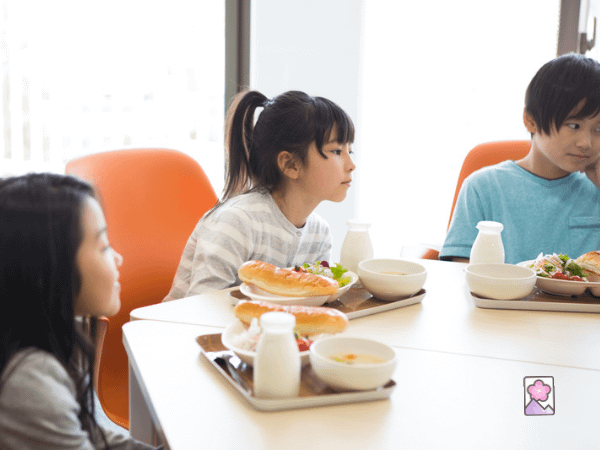
Sesame and crustaceans are common allergens in Japan, and school kitchens and nutritionists make sure that no kid experiences adverse effects due to food allergies.
Alternative lunch is not usually offered, but allergen-free arrangements are made if possible. For example, a child allergic to shrimp may get a double serving of miso soup and more rice, to make up for the food they can’t eat.
Non-medical food restrictions, like being vegan or religious food restrictions, are generally not accommodated. However, kids with special diets can opt out of the lunch program, and bring their own lunch box to school.
Beyond sustenance, the Japanese school lunch system is an educational experience that nurtures essential life skills. “Kyushoku” helps kids learn self-reliance but also cooperation, good nutrition habits and portion control, but also the importance of not wasting food. It comes with a wide variety of tasks that kids distribute among themselves, for everyone’s enjoyment.
The result? Satiated, healthy children with a strong sense of community and good life-skill basics. Win-win.